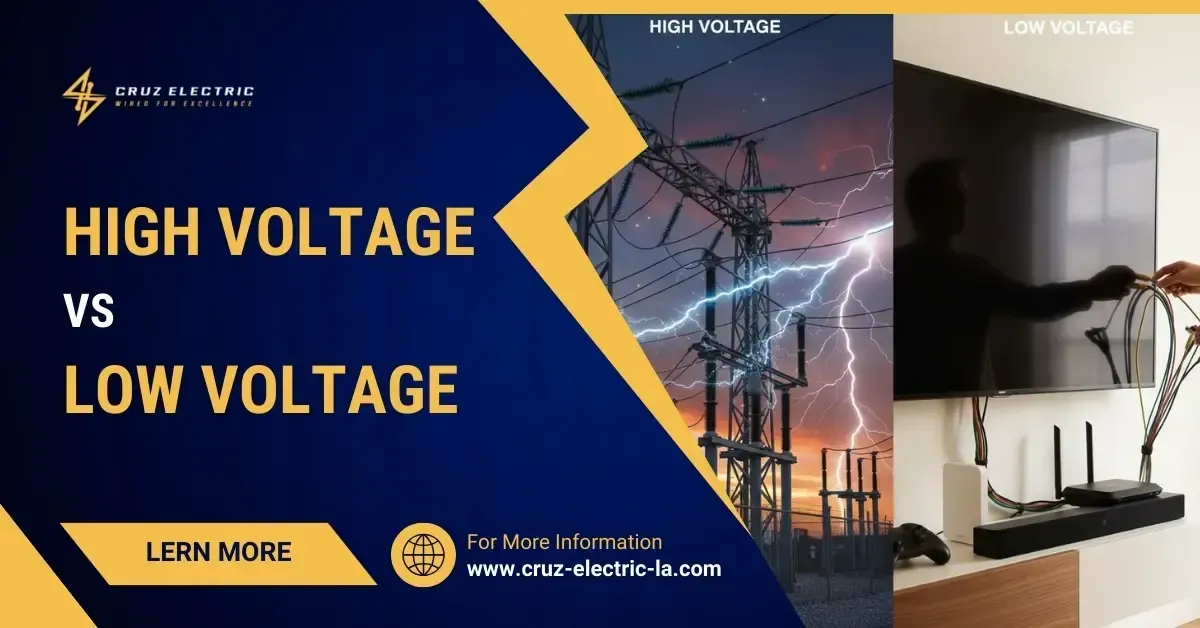
High Voltage vs Low Voltage: Key Differences
High voltage (over 1000V) can kill you instantly, while low voltage (under 50V) powers safe stuff like doorbells and thermostats. Ever wonder why your doorbell installer didn't need a license, but the guy rewiring your garage did? It's all about voltage. Most people in La Puente, CA don't think about this stuff until something breaks, usually at the worst time, like the middle of summer when the AC quits.
Knowing the difference between low voltage and high voltage isn't just electrician stuff. It helps you figure out what's a weekend project and what needs Cruz Electric on speed dial. With La Puente summers cooking our electrical systems every year, understanding voltage saves you cash and maybe your life. Let's explore the differences without the technical garbage.
What Is High Voltage?
High voltage is anything over 1000 volts, the kind that jumps through air and kills you before you hit the ground. See those massive metal towers with thick cables? That's high voltage hauling electricity from power plants way out in the desert to your neighborhood. Serious power that doesn't need you to touch it'll arc through the air and fry you from three feet away.
Transformers at substations knock that crazy power down to something your house can use. Otherwise, your toaster would explode. Those transmission lines run everywhere in La Puente. They're why your AC keeps going when it's 105 outside. Only licensed electricians touch high voltage. Our crew at Cruz Electric has been doing this for 20+ years and still treats it like a loaded gun. Because it is. One mistake and you're done. The arc alone melts metal.
What Is Low Voltage?
Low voltage runs under 50 volts and powers safe everyday stuff like doorbells, thermostats, and garden lights.
Pretty much all your smart home gadgets run on low voltage:
Ring doorbells and video cameras
Nest thermostats and smart home controls
Solar path lights and landscape lighting
Security systems and alarm sensors
WiFi routers and telecommunications equipment
That chunky black box on your phone charger is a transformer that converts regular power to the low voltage your phone needs. Touch a low-voltage wire, and maybe you feel a tingle, but it won't stop your heart. That's why people install security systems themselves.
La Puente's got tons of old houses. Low-voltage upgrades work perfect modern tech without ripping out your walls.
Main Differences Between High and Low Voltage
The difference between low voltage and high voltage comes down to danger level, cost, and who can touch it without dying.
Power They Carry
High voltage is a fire hose; low voltage is your garden hose. Different jobs, different power.
Cruz Electric had a guy last month trying to run a compressor on low voltage. Didn't work. Wrong tool for the job.
Safety Rules
Low voltage (under 50V) is DIY-friendly; high voltage (over 1000V) requires licensed pros, or you die.
OSHA says anything at 50 volts or higher needs real protection. High voltage work means full safety gear, training, permits, inspections, everything.
But damaged wiring still starts fires. Not sure what you're doing? Make the call.
Installation Costs
Low voltage is cheap upfront, but high voltage saves money long-term on energy bills.
Want security cameras or smart lights? Maybe $200-300 in parts. You can do it yourself. High voltage work? Thousands. thick cable, professional labor, permits, and inspection fees add up fast.
But high voltage wastes less energy moving electricity around. Your monthly bills stay lower. For houses, though, low voltage usually wins on total cost.
Cables and Equipment
High voltage cable is a thick rope with multiple protective layers; low voltage wire is thin and bendable. High-voltage gear survives anything built to last 50 years in nasty weather. Costs more but rarely breaks. Low-voltage stuff is cheap and simple to run through walls. Both work great when installed correctly.
Where High Voltage Gets Used
High voltage powers transmission lines, factories, big commercial buildings, and industrial plants. Every light switch you flip in La Puente works because high voltage is transmitted to that electricity from some power plant miles away.
The Department of Energy uses up to 765,000 volts to move power efficiently across long distances. Less energy loss that way.
You'll find high voltage running:
Power plants and substations
Transmission lines on metal towers
Big manufacturing facilities
Car factories with heavy presses
Data centers are burning serious power
Industrial HVAC systems and machinery
Where Low Voltage Gets Used
Low voltage runs your doorbell, thermostat, LED lighting, security systems, and basically all smart home stuff.
Walk through your house and spot low voltage everywhere:
Thermostat controlling your AC
Doorbell and intercom systems
Security cameras and motion sensors
WiFi router and cable box
Garage door opener controls
Landscape and pathway lights
Smart speakers and home automation
Telecommunications equipment
Cruz Electric does tons of low-voltage work in La Puente. Smart thermostats cut cooling costs in summer heat. LED lights are dropping electric power bills by half.
Energy Efficiency: Which Wins?
High voltage wins for efficient energy use when moving power long distances; low voltage wins for home devices.
High voltage cuts energy loss when electricity travels miles. Fewer turns to heat, more power reaches the end. That's why the electrical grid uses it step up for transport, step down for homes.
For one building, low voltage makes more sense. Less heat, simpler setup, perfect for home appliances. Your phone charger barely gets warm because low voltage is efficient for small loads.
Safety Risks You Need to Know
High voltage kills instantly; low voltage is less dangerous, but damaged wiring still causes fires. Let's be straight, high voltage is deadly. Over 1000 volts will kill you. The arc flash burns hotter than the sun. You don't even need to touch it.
50 volts usually won't kill you. Might hurt if you're sweating or have heart problems. And damaged low-voltage wiring absolutely starts fires, especially in La Puente's old houses.
Basic safety rules:
Never touch high-voltage equipment or wiring
Call Cruz Electric for any work over 1000 volts
Use proper insulation on all electrical installations
Install fire safety devices in older homes
Follow local codes, no shortcuts
Keep kids away from damaged wire
Learn more about electrical safety: Top 10 Electrical Safety Tips to Protect Your Residential Wiring in Los Angeles, CA
Which One Should You Use?
Pick low voltage for home upgrades; only use high voltage when you absolutely need massive power.
Ask yourself these questions:
What equipment needs power?
How much voltage does it actually need?
Who's doing the installation work?
What's your total budget?
Is this temporary or permanent?
Low voltage handles most home projects. Solar power controls, battery chargers, and wind power setups are mostly low-voltage these days. Modern technology uses less power.
Need high voltage? Then you need it. Simple. Cruz Electric knows every weird setup in La Puente. We've seen it all. Low-voltage doorbells or high-voltage shop equipment, we've got you.
FAQs
Can I install low voltage myself?
Yes, most low-voltage projects don't need permits here. Just use common sense and follow basic safety rules.
Do I need a permit for high-voltage work?
Always. High-voltage requires licensed pros and permits. No shortcuts, no exceptions.
Which lasts longer?
Both last forever with proper maintenance. High-voltage gear costs more, but it's built tougher for harsh conditions.
Can you mix high and low-voltage?
Never mix them directly. Always use a transformer to step down voltage safely. Mixing them kills people.
How do I know what voltage my home uses?
Check your electrical panel labels or call Cruz Electric for a free inspection and assessment.
Conclusion
That's it. High voltage vs low voltage without making your head hurt. Most home upgrades need low-voltage, safer, cheaper, and easier solutions. High voltage is for serious power jobs. Adding security cameras? Upgrading lighting? Need electrical work? Cruz Electric handles it. Cruz Electric Electrician in La Puente, California, has the expertise and knows what works. Pick the right system, stay safe, and call a pro when you're not sure. Getting shocked sucks. Dying from it sucks worse.
